


Top 25 Symphonic Rock Songs
Top 25 Symphonic Rock Songs

Michael Gallucci Wed, October 28, 2026 at 12:36 PM UTC
32
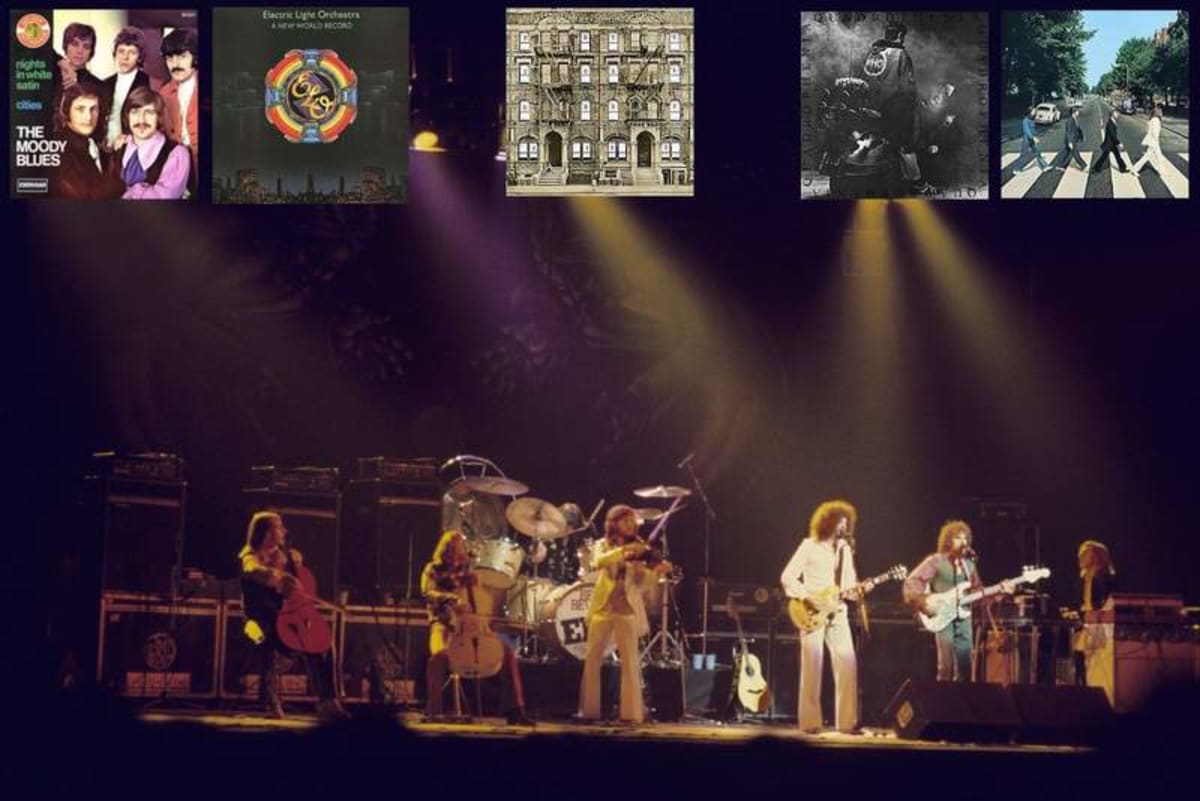
©Tom Hill, WireImage, Getty Images
The best symphonic rock songs emerged from a fertile period in late-’60s music history, when the psychedelic era’s baroque influences grew more ambitious in scope and style.
Not content to add just a couple of string instruments to their arrangements, the most versatile and adaptable of these artists often hired full orchestras to realize their grand rock dreams, as outlined in the UCR staff’s list of the Top 25 Symphonic Rock Songs.
All of the songs on the list below include a live orchestra, except one. That was the basic requirement for inclusion, whether it was the early pairing of a rock band with a symphony orchestra on the Moody Blues‘ landmark Days of Future Passedor the Verve’s appropriation of an old Rolling Stones song for a controversial ’90s hit. Put on your black tie and dig in.
25. Oasis, “Whatever” (From 1994 single)
Released as a stand-alone Christmas single between Oasis‘ first and second albums, “Whatever” leans into their Beatles migrations with descending strings straight out of “I Am the Walrus.” Another link to the past: The London Session Orchestra performs the strings and features former Electric Light Orchestra violinist Wilfred Gibson.
Subscribe to Ultimate Classic Rock on Youtube
24. Roy Orbison, “In Dreams” (From In Dreams, 1963)
Although Roy Orbison‘s “In Dreams” reached the Top 10 upon its 1963 release, it attracted a new audience when David Lynch featured it in his 1986 film Blue Velvet. Framed by an orchestra and a baroque arrangement, like most of the singer’s Monument recordings, the song reaches octave-shattering heights of drama in 2:48.
Subscribe to Ultimate Classic Rock on Youtube
23. John Lennon, “#9 Dream” (From Walls and Bridges, 1974)
While working on Pussy Cats, John Lennon incorporated a string arrangement he had originally written for the 1974 Harry Nilsson album into a song from his own album that year, Walls and Bridges. Lennon has said the hypnotic “#9 Dream” fittingly came to him in a dream, untangling the song’s surreal, cloudlike atmosphere and nonsense chorus.
Subscribe to Ultimate Classic Rock on Youtube
READ MORE: Top 100 Rock Songs of All Time
22. Tom Petty, “It’s Good to Be King” (From Wildflowers, 1994)
ELO mastermind Jeff Lynne helped set Tom Petty‘s 1989 comeback with his first solo album, Full Moon Fever. By 1994, when he released his second solo LP, he had moved on to Rick Rubin, whose fly-on-the-wall production style suited Wildflowers‘ reflectivetone. “It’s Good to Be King” is aided by Michael Kamen-arranged strings.
Subscribe to Ultimate Classic Rock on Youtube
21. Simon and Garfunkel, “Bridge Over Troubled Water” (From Bridge Over Troubled Water, 1970)
A slow build over nearly five minutes, “Bridge Over Troubled Water” quickly became the capstone of Simon and Garfunkel‘s career. Paul Simon wrote the song as a gospel hymn for Art Garfunkel to sing solo, but Garfunkel turned down the offer. The Wrecking Crew provides graceful backing before a gust of strings breaks in for the climactic end.
Subscribe to Ultimate Classic Rock on Youtube
20. Bruce Springsteen, “Jungleland” (From Born to Run, 1975)
Bruce Springsteen debuted “Jungleland” live in July 1974, more than a year before it appeared on Born to Run. The song still followed the loose, jazz patterns of his second album, The Wild, the Innocent and the E Street Shufflethen. But the departure of two band members, along with added strings and a violin intro, gave it its classic shape.
Subscribe to Ultimate Classic Rock on Youtube
19. Elton John, “Levon” (From Madman Across the Water, 1971)
London-born arranger Paul Buckmaster began working with producer Gus Dudgeon on David Bowie‘s 1969 LP. When Dudgeon was hired to produce Elton John‘s 1970 self-titled album, he enlisted Buckmaster to arrange the orchestra. “Levon,” from John’s fourth LP, Madman Across the Water, stands out among their many collaborations.
Subscribe to Ultimate Classic Rock on Youtube
18. Electric Light Orchestra, “Can’t Get It Out of My Head” (FromEldorado, 1974)
Electric Light Orchestra began to find its identity on its fourth album, 1974’sEldorado, a concept LP that still managed to include its most radio-ready pop music up to that point. “Can’t Get It Out of My Head” was their first Top 10 hit in the U.S., a soft rock gem with an orchestral arrangement that toes the line between progressive and Beatlesque.
Subscribe to Ultimate Classic Rock on Youtube
17. David Bowie, “Life on Mars?” (From Hunky Dory, 1971)
Four albums in, David Bowie had finally become David Bowie. Hunky Dory brought together the artist with a team (including guitarist Mick Ronson and producer Ken Scott) who’d help shape Ziggy Stardust. The LP’s pivotal “Life on Mars? rests on a bed of celli, string basses, violas and violins performed by the BBC Symphony Orchestra.
Subscribe to Ultimate Classic Rock on Youtube
16. Nilsson, “Without You” (From Nilsson Schmilsson, 1971)
Written and first recorded by Badfinger on their 1970 album No Dice, “Without You” became a No. 1 hit for Nilsson a year later thanks to an impassioned performance and Paul Buckmaster’s exhilarating string arrangement. It’s the commercial center of an undervalued catalog by an artist who detoured from one post to another in the ’70s.
Subscribe to Ultimate Classic Rock on Youtube
15. Guns N’ Roses, “November Rain” (From Use Your Illusion I, 1991)
Guns N’ Roses‘ “November Rain” bends the rules a bit. The song’s strings are synthesized, not played by a live orchestra. But the ballad exhibits all the hallmarks of a big symphonic rock number: a sweeping orchestral center, a dominant role in the arrangement, and a nearly nine-minute length, a record at the time for a Top 10 hit.
Subscribe to Ultimate Classic Rock on Youtube
READ MORE: 65 Best Album Covers of All Time
14. Electric Light Orchestra, “Mr. Blue Sky” (From Out of the Blue, 1977)
While writing the follow-up to 1976’s hit A New World Record, Jeff Lynne secluded himself in a Swiss chalet, where Electric Light Orchestra’s most popular song came together after the bandleader spotted the sun rising after several gray days. “Mr Blue Sky” concluded Out of the Blue‘s nearly 18-minute “Concerto for a Rainy Day” suite.
Advertisement
Subscribe to Ultimate Classic Rock on Youtube
13. R.E.M., “Nightswimming” (From Automatic for the People, 1992)
After scoring their first No. 1 with 1991’s Out of Time, R.E.M. scaled back for their eighth album, the mournful and reflective Automatic for the People. With orchestral arrangements by Led Zeppelin bassist John Paul Jones, “Nightswimming” is the band’s loveliest track, a nostalgic look back at a younger, more carefree time in their lives.
Subscribe to Ultimate Classic Rock on Youtube
12. Electric Light Orchestra, “Telephone Line” (From A New World Record, 1976)
The final single from A New World Record was released seven months after the LP and reached the Top 10, becoming Electric Light Orchestra’s highest-charting hit to date. The opening ringing of “Telephone Line” was played on a Moog for its slightly otherworldly feel. The song also helped the album reach a chart peak at the time.
Subscribe to Ultimate Classic Rock on Youtube
11. The Smashing Pumpkins, “Tonight, Tonight” (From Mellon Collie and the Infinite Sadness, 1995)
From the three-minute instrumental that opens 1995’s double-LP Mellon Collie and the Infinite Sadness, it’s clear the Smashing Pumpkins are aiming big on their third album. The title track segues into the symphonic “Tonight, Tonight,” a majestic introduction featuring the Chicago Symphony Orchestra — the result: the band’s only No. 1 album.
Subscribe to Ultimate Classic Rock on Youtube
10. The Rolling Stones, “Moonlight Mile” (From Sticky Fingers, 1971)
From the Rolling Stones’ golden period comes a song about their grueling 1970 tour, written as the band struggled to cope with rising expectations, especially for Keith Richards, who doesn’t appear on “Moonlight Mile.” Paul Buckmaster’s oblique, haunting and exceptional string arrangement adds to the song’s ghostly melancholy.
Subscribe to Ultimate Classic Rock on Youtube
9. Wings, “Live and Let Die” (From Live and Let Die, 1973)
Before they even had a finished screenplay, the producers of the James Bond film series asked Paul McCartney to write a song for the next installment. McCartney brought in Beatles producer George Martin to work on the song and arrange parts for the London Symphony Orchestra. “Live and Let Die” was 007’s first rock song.
Subscribe to Ultimate Classic Rock on Youtube
8. The Verve, “Bitter Sweet Symphony” (From Urban Hymns, 1997)
Richard Ashcroft created “Bitter Sweet Symphony” from a sample of the Andrew Oldham Orchestra’s 1965 version of the Rolling Stones’ “The Last Time.” Its long, troubled history — in which the Verve ceded royalties and songwriter credit — doesn’t diminish the song’s powerful pull, with its sweeping strings and deliberate momentum.
Subscribe to Ultimate Classic Rock on Youtube
7. The Moody Blues, “Nights in White Satin” (From Days of Future Passed, 1967)
In 1967, the Moody Blues were at the vanguard of the progressive rock movement when they released their second LP, the trendsetting Days of Future Passed, which featured the former R&B group performing with the London Festival Orchestra at their label’s request. “Nights in White Satin” is the centerpiece, blending pop and classical.
Subscribe to Ultimate Classic Rock on Youtube
READ MORE: Top 250 American Songs
6. The Beatles, “A Day in the Life” (From Sgt. Pepper’s Lonely Hearts Club Band, 1967)
The 40-piece orchestra appended to the Beatles’ epic Sgt. Pepper’s Lonely Hearts Club Band closer doesn’t have much to do until the final minute or so. It adds transitional bridges to “A Day in the Life”‘s middle section, but the dissonant and layered crescendo leading up to the famous 40-second piano chord crashes the scene and makes history.
Subscribe to Ultimate Classic Rock on Youtube
5. The Who, “Love, Reign O’er Me” (From Quadrophenia, 1973)
Pete Townshend knew what he had in “Love Reign O’er Me,” the emotionally rousing track that closes the Who‘s 1973 rock opera Quadrophenia. The song is not only the LP’s anchor, but it has also been a live highlight for decades. Townshend wrote “Love Reign O’er Me” as a spare ballad; Roger Daltrey brought the blazing payoff.
Subscribe to Ultimate Classic Rock on Youtube
4. Electric Light Orchestra, “Livin’ Thing” (From A New World Record, 1976)
Electric Light Orchestra still took the “orchestra” part of their name seriously when they released one of their biggest hits in 1976. The sublime “Livin’ Thing” begins with a classical, pizzicato-string introduction before launching into one of the group’s catchiest songs, equally inspired by George Harrison and a Victorian-era chord structure.
Subscribe to Ultimate Classic Rock on Youtube
3. Elton John, “Tiny Dancer” (From Madman Across the Water, 1971)
“Tiny Dancer” barely registered when it was released as a single in early 1972, not even making the Billboard Top 40 (the U.K. skipped a single release altogether). But over the years, it has become one of Elton John’s most popular songs, thanks to Paul Buckmaster’s stirring strings and John and Bernie Taupin‘s flawless composition.
Subscribe to Ultimate Classic Rock on Youtube
2. The Beatles, “Golden Slumbers/Carry That Weight/The End” (From Abbey Road, 1969)
Taken together, the Side Two medley that closes the Beatles’ last recorded album is a masterwork of pacing, editing and performance that ranks among the group’s best works. The triple-part, strings-aided highlight “Golden Slumbers/Carry That Weight/The End” closes not only Abbey Roadbut also the Beatles’ time in the studio together.
Subscribe to Ultimate Classic Rock on Youtube
1. Led Zeppelin, “Kashmir” (From Physical Graffiti, 1975)
Led Zeppelin first incorporated world music into their heavy blend of blues and ’60s rock in Led Zeppelin III‘s “Friends,” but with “Kashmir,” released two years later on the double Physical Graffiti, they set it atop a hulking set piece that starts large and only proceeds to build and build over eight-and-a-half colossal minutes. Jimmy Page and Robert Plant began work on “Kashmir” three years earlier, after the singer visited a Moroccan desert (none of the group members had actually been to the Indian subcontinent at the time). John Bonham added mammoth drumming to Page and Plant’s demo, followed by John Paul Jones’ orchestral arrangement. Session musicians then provided strings and horns. The song quickly became a Led Zeppelin concert staple, including solo dates by Page and Plant, who often performed the song live with an orchestra.
Subscribe to Ultimate Classic Rock on Youtube
Source: “AOL Entertainment”
